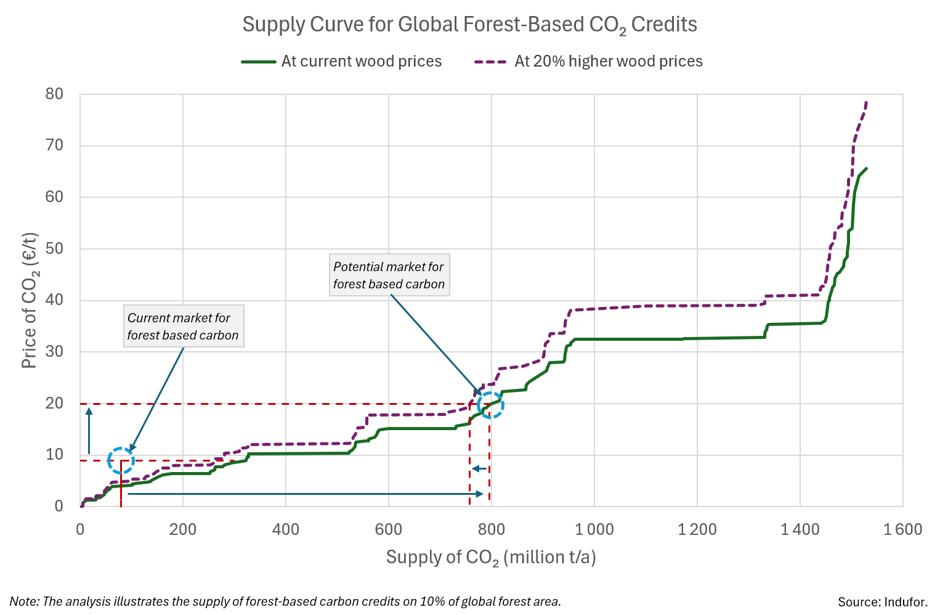
The global carbon credit market recognises forests as an instrument to mitigate industrial carbon emissions. In recent years, the market for forest-based carbon credits has been around €300 million/a, equating to CO2 sequestration of about 40 million t CO2 through the biological growth of forests.
However, the average forest-based carbon credit price has been in the range of €8-€10/t of CO2. The price has been very low compared to, e.g., the CO2 price of €75 to €85/t realised recently in the European Emission Trading System (ETS). In general, the price for forest-based carbon is expected to evolve with the increasing demand for carbon credits.
As derived by Indufor, the supply of forest-based carbon is rather elastic with respect to the price of CO2 credits. In other words, relatively limited increases in carbon price would result in remarkably expanded carbon supply. Increasing the price for forest-based carbon, say, to €20/t of CO2 (i.e. to a level of about 25% of the current price of CO2 within ETS) could encourage forest owners to expand the supply of carbon credits by a multiple, potentially from 40 to 800 million t of CO2/a, i.e. 20 times larger.
To be effective, carbon farming should be applied while constraining the impact on wood harvesting. If wood prices were to increase due to reduced harvesting levels, the resulting foregone revenue by forest owners tends to increase the effective cost (opportunity cost) of carbon, further reducing the supply of forest-based credits. For example, a 20% increase in wood prices would reduce the annual supply by 50 million CO2 tonnes at the level of €20/t of CO2. As a solution, it might be optimal to consider expanding carbon farming on, e.g. 10% of forest land-specific designated areas, i.e. within a similar scale to the set-aside requirements of conventional forest certification schemes. Such scale would be sufficient to achieve major expansion in the forest-based carbon market.
Indufor’s research data covers 159 countries globally, comprising forest resources including biological growth, forest area, wood prices and carbon sequestration by country. The data by country has been derived based on Indufor’s proprietary databases, United Nations FAO, and national sources. To calculate the annual CO2 sequestration, only the above-ground biomass was considered together with the conversion factors from the 2006 IPCC Guidelines for National Greenhouse Gas Inventories and the 2019 Refinement.
For further information, please contact:
Diego Rivera, Indufor Data & Technology, +358 41 325 6695, diego.rivera@induforgroup.com
Topi Pohjankoski, Indufor Data & Technology, +358 45 267 0894, topi.pohjankoski@induforgroup.com
Elias Pekari, Indufor Data & Technology, +358 40 091 2591, elias.pekari@induforgroup.com